Random Word Generator Guide — Word Lists, Lorem Ipsum, Writing Prompts
Overcome cognitive blocks and accelerate your workflow with a free offline random word generator. Experience secure, zero-latency client-side processing.

Table of Contents
Last updated: June 2026
🔴 What Random Word Generators Are Actually Used For
The term “random word generator” covers a surprisingly broad set of professional and creative workflows. In user interface design, random words populate form fields, table cells, dropdown menus, and card layouts during wireframing and prototyping — revealing layout problems (truncation, overflow, alignment) that identical placeholder text like “Lorem ipsum” cannot expose because its character distribution differs from English. In game design, random word lists seed word puzzles, Scrabble-type games, word association challenges, and vocabulary card games. In education, teachers generate spelling lists, vocabulary exercises, and writing prompts. In brand naming, agencies generate word combinations looking for phonetically interesting compound names. In content marketing, writers use random word prompts to break creative blocks and explore unexpected topic angles.
🟡 Parts of Speech — Why Mixing Word Types Produces Better Results
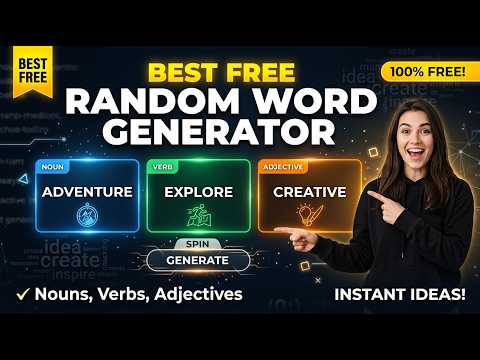
English has eight traditional parts of speech: nouns, verbs, adjectives, adverbs, pronouns, prepositions, conjunctions, and interjections. For vocabulary generation purposes, the most productive mix is nouns, verbs, and adjectives — the three content word categories that carry most of a sentence’s meaning. Pronouns and prepositions are function words: they connect and reference other words rather than carrying independent meaning, making them less useful as standalone random words for most creative purposes. Adverbs add interesting texture — words like silently, effortlessly, brilliantly, ferociously describe how actions happen and add colour to writing exercises.
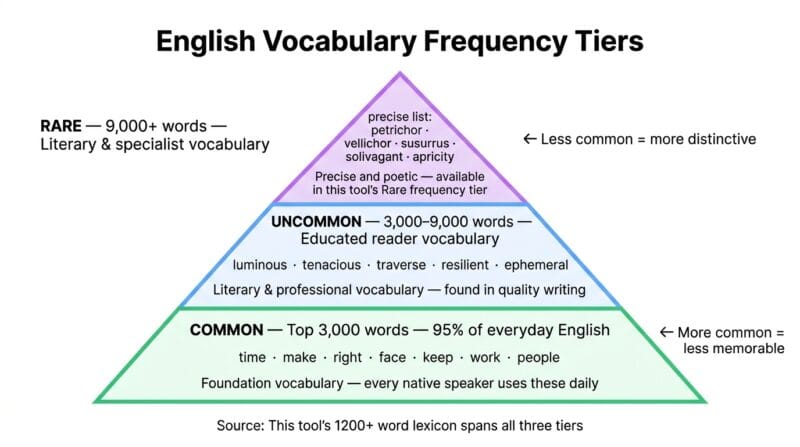
Lexicographers distinguish three frequency bands in English vocabulary. High-frequency words (the core 2000–3000 words) cover approximately 95% of everyday spoken and written English — these are the words every native speaker uses without thinking. Mid-frequency words (3000–9000) include the vocabulary of educated general readers — the words you encounter in newspapers, quality fiction, and professional writing. Low-frequency words (9000+) are the specialist, literary, and archaic vocabulary that characterises academic writing, literary fiction, and poetry. For a random word generator targeting creative writers, the most valuable tier is mid-frequency — common enough to be understood immediately, uncommon enough to break habitual vocabulary patterns.
🟢 Alliteration — The Literary Device and Its Practical Uses
Alliteration is the repetition of the same initial consonant sound in consecutive or closely positioned words. “Peter Piper picked a peck of pickled peppers” is the textbook example — but alliteration in professional writing is subtler and more deliberate. Brand names use alliteration for memorability: Coca-Cola, PayPal, Krispy Kreme, Dunkin’ Donuts. Headlines use it for rhythm and recall. Poetry uses it to create sound texture and emphasis. SEO copywriters use it in headings to make content more scannable and memorable. The Alliteration Generator in the Toolkit tab produces a set of words beginning with the same letter, drawn from across the full lexicon — nouns, verbs, and adjectives together. A set like “silvery, serene, solivagant, summit, sculpt, steadily” gives a writer raw material for constructing a themed passage with consistent sonic texture.
🟢 Stop Words in SEO and Content Analysis
The concept of stop words in computational linguistics refers to words so common they carry no useful signal for search or text analysis — they appear in nearly every document and therefore cannot distinguish one document from another. Early search engines like AltaVista and the original Google implementation excluded stop words from their indexes to save disk space. Modern search engines handle them more contextually — “to be or not to be” is a meaningful phrase despite consisting entirely of stop words — but the concept remains relevant in several practical workflows.
In keyword research, removing stop words from a block of text quickly surfaces the semantic keywords — the words that actually describe the topic. Paste a competitor’s blog post introduction into the Stats tab, then use the Stop Words Remover to extract the keyword set — you can see which content words they have weighted without manually reading and noting every word. In natural language processing pipelines, stop word removal is a standard preprocessing step before sentiment analysis, topic modelling, and text classification. The standard English stop word list includes approximately 150–300 words depending on the implementation — this tool’s list covers the 120 most common English stop words while preserving meaningful short words like “not,” “no,” and “never” that affect sentiment. For vocabulary analysis tools see our Ultimate Word Studio Pro. For more content creation guidance read our complete word generator guide.
🟡 Writing Prompts — How Constraints Unlock Creativity
The apparent paradox of writing prompts is that constraints produce creativity rather than limiting it. A blank page offers infinite possibilities — which is precisely why it produces paralysis. A specific constraint (“write about a retired spy who runs a bookshop”) immediately closes off most possibilities and opens a specific creative direction. Cognitive science research suggests the brain generates more creative solutions under constrained conditions because constraints prevent the mind from defaulting to the first obvious answer and force deeper associative search.
Story Starter prompts provide an opening line — the moment when a story has already begun, a character exists, and the reader’s curiosity is already engaged. The most effective story starters create immediate questions: “The letter arrived three weeks after her death, postmarked the day she disappeared” — who died, why does the postmark date matter, what is in the letter? The reader wants to know. Character prompts provide a character type in a situation rather than a full character description — a lighthouse keeper who has not spoken to another person in eleven years is a situation with immediate character questions. Setting prompts specify a physical location with an unusual quality — a market that appears only on the first Saturday of each month and sells things you cannot name provides a world with internal logic to explore. Conflict prompts describe a tension between characters or forces without prescribing the resolution. Plot Twist prompts provide a revelation that recontextualises a familiar story type — the villain was trying to prevent the same thing the hero was trying to cause.
- 🔵 Word scrambling has two distinct professional uses: anagram puzzle creation (scramble a word, give solvers the jumbled version) and data anonymisation (make sample data less recognisable in screenshots by scrambling names while keeping character counts).
- 🟠 Vocabulary richness measurement using TTR (Type-Token Ratio) is a standard metric in academic linguistics for comparing writing samples, assessing language learner progress, and evaluating text complexity. A TTR above 70% in a 300-word passage indicates sophisticated vocabulary use.
- 🟣 Character names affect reader subconscious expectations — Anglo-Saxon names like James or Eleanor suggest one cultural context; Celtic names like Saoirse or Cillian suggest another. Name origin matching to your story’s cultural setting significantly affects a reader’s immersion in the fictional world.
What is the difference between a noun, verb, adjective, and adverb?
Nouns name people, places, things, and ideas — “river,” “teacher,” “solitude.” Verbs describe actions, states, and processes — “traverse,” “illuminate,” “become.” Adjectives modify nouns, describing qualities — “luminous,” “tenacious,” “pristine.” Adverbs modify verbs, adjectives, or other adverbs, describing how, when, where, or to what degree — “silently,” “effortlessly,” “brilliantly.” Together, nouns, verbs, and adjectives form the core content words of English — the words that carry meaning rather than grammatical structure.
Is Lorem Ipsum real Latin or invented text?
Lorem Ipsum is modified real Latin — it derives from Book 1, Section 1.10.32 of Cicero’s “de Finibus Bonorum et Malorum” (On the Ends of Good and Evil), written in 45 BC. The standard Lorem Ipsum passage has been scrambled and words have been added, removed, and altered to make it meaningless while retaining the visual appearance of natural Latin prose. The opening words “Lorem ipsum” come from “dolorem ipsum” (the pain itself) — a phrase Cicero used in a discussion of pleasure and pain. Type designer Richard McClintock traced the original source in 1994.
How many words do I need to know to be fluent in English?
Research in applied linguistics suggests that knowing the most frequent 2000 word families covers approximately 95% of everyday spoken English and 90% of general written text. University-level reading requires knowledge of approximately 8000–9000 word families. Native educated adults typically have passive vocabulary of 25,000–35,000 word families. The “rare” tier in this tool contains words from approximately the 8000–15,000 frequency band — known to educated readers but rarely used in everyday conversation, which is precisely what makes them valuable for adding precision to writing.
What makes a writing prompt effective?
Effective writing prompts create immediate questions the writer wants to answer. The best prompts are specific enough to provide direction but open enough to allow creative choices. They should imply character, conflict, or consequence without spelling them out — “The last train left at midnight. He was on it. She was not supposed to be” implies a relationship, a situation, and a decision without dictating the story. Prompts that specify emotions (“write about sadness”) are generally less generative than prompts that specify situations (“write about someone returning to a house they thought they’d never see again”).
What is the Type-Token Ratio and how accurate is it as a readability measure?
The Type-Token Ratio (TTR) — unique words divided by total words — is one of the simplest and most widely criticised measures of vocabulary richness. Its main limitation is length-dependence: longer texts mechanically produce lower TTR because common words repeat more frequently in longer passages. A 50-word text may show 90% TTR while a 5000-word text of equal writing quality might show 40% TTR. More sophisticated measures like MTLD (Measure of Textual Lexical Diversity) and HD-D compensate for length, but require complex calculation. For texts under 500 words, TTR provides a useful comparative measure — particularly for comparing multiple passages of similar length written by the same author.
What is an anagram and how does the Word Scrambler help create them?
An anagram is a word or phrase formed by rearranging all the letters of another word — “listen” → “silent,” “envy” → “very” (with an extra letter), “astronomer” → “moon starer.” The Word Scrambler in the Toolkit tab jumbles the letters of your input words randomly rather than finding actual valid anagram words — this is useful for creating puzzles where solvers must find the original word from the scrambled version. For finding actual valid English anagram solutions, you would need a full anagram solver dictionary, which is beyond offline scope. The scrambler is designed for puzzle creation, teaching word structure, and data anonymisation.
Can I use randomly generated words for brand names?
Yes — with verification. Random word generation is a legitimate part of brand naming brainstorming, particularly for finding short, phonetically interesting words that can be trademarked. The key requirement: verify that the generated name is not already trademarked in your product category and territory before investing in it. Pure dictionary words can be trademarked for specific commercial categories — “Apple” is trademarked for computers. Blended or invented words (combining two word roots, scrambling letters, adding suffixes) generally have cleaner trademark paths. Use the Rare vocabulary tier and the Scrambler together to find unusual combinations as starting points for brand naming.
What is the difference between placeholders for designers vs developers?
Designers primarily need visual placeholder text that reveals typographic and layout behaviour — Classic Lorem Ipsum or Scrambled Real English works well because it creates realistic character density without distracting reviewers with actual content. Developers often need structured placeholder data for testing — JSON Array format from the Words tab provides ready-to-use test data arrays, numbered lists work for testing ordered list rendering, and comma-separated format works for populating select/dropdown menus. For database testing, the Stats Analyzer’s word frequency table can provide realistic word-count distributions for seeding search index test data.
How are the sentence tenses generated?
The sentence generator applies three tense rules to verb stems. Present tense adds “-s” to the verb stem (traverse → traverses, illuminate → illuminates). Past tense uses a simple rule set: verbs ending in “-e” add “-d” (traverse → traversed), verbs ending in consonant + “y” change “y” to “-ied” (try → tried), and other verbs add “-ed” (illuminate → illuminated). Future tense prepends “will” to the bare infinitive without modification. These rules handle the majority of regular English verbs correctly — irregular verbs (go → went, be → was) are avoided in the verb lexicon used for sentence generation to prevent grammatically incorrect output.