Offline Markdown to PDF Converter: Free Client-Side Tool
Stop primary key collisions with our Free Offline Markdown to PDF Converter. Create and validate millions of secure v4 tokens locally in your browser.
🟥 The Complete Developer Guide to Using an Offline Markdown to PDF Converter
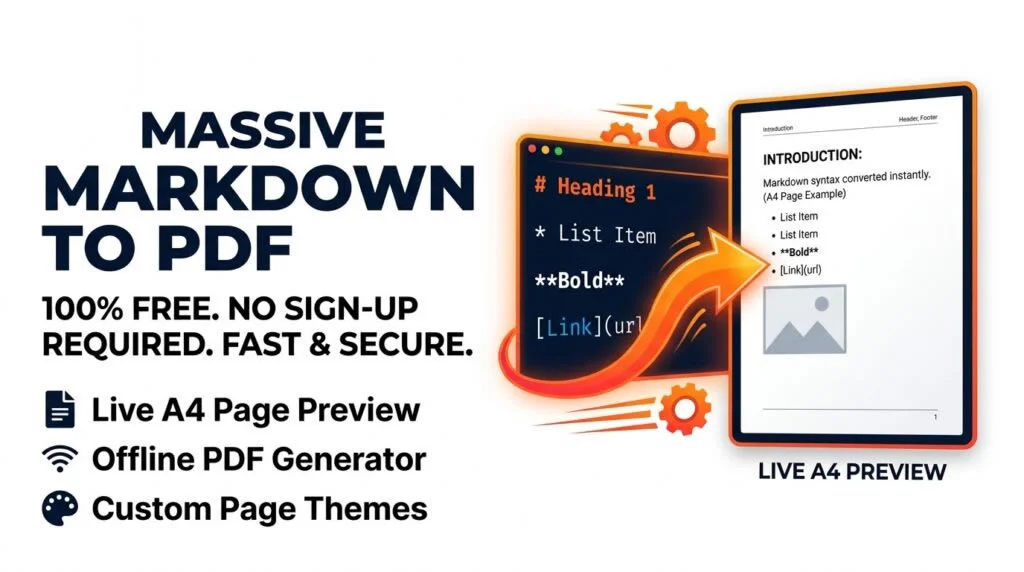
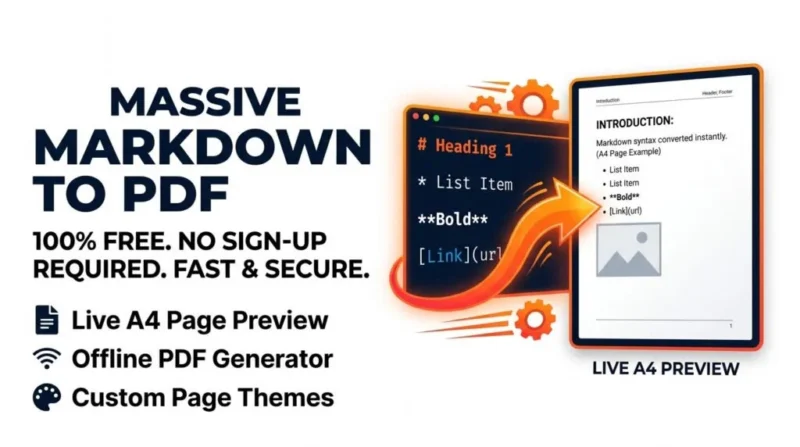
Every technical writer, software engineer, and academic researcher faces the exact same frustrating problem when creating documentation. Traditional word processors are heavy, slow, and completely ruin code formatting. Because of this structural flaw, writing in simple plain text using lightweight markup languages has become the absolute industry standard. However, sharing those raw text files with non-technical clients or managers is simply not an option. They expect polished, professional, printable documents. To bridge this exact gap, you need a high-quality Offline Markdown to PDF Converter. This specific tool allows you to write at lightning speed in plain text and instantly generate a beautifully formatted document directly inside your web browser.
🟧 The History and Need for Plain Text
To understand why an Offline Markdown to PDF Converter is so valuable for digital workflows, you must look at the history of digital writing. In 2004, John Gruber created the original syntax rules. His vision was to allow people to write using an easy-to-read format that a parser could structurally convert into valid HTML. You can read the original design philosophy and syntax rules on the Daring Fireball project page.
While this raw format is perfect for developers building web pages, the corporate business world still universally demands the Portable Document Format for invoices, legal contracts, and physical API manuals. A dedicated Offline Markdown to PDF Converter acts as the crucial compilation engine. It translates your structural syntax into a locked, paginated file that anyone can easily open on any device without needing a specialized code editor.
What makes a modern Offline Markdown to PDF Converter truly special is how it handles this entire compilation pipeline completely on your local device. Older utilities required you to upload your `.md` files to a remote backend server, wait in a processing queue, and download the finished file. This old method is extremely slow and highly insecure. A modern Offline Markdown to PDF Converter uses your browser’s internal JavaScript engine to execute a massive multi-stage rendering process in just a few milliseconds.
🟦 The Computational Process Inside an Offline Markdown to PDF Converter
When you type or paste your plain text into an Offline Markdown to PDF Converter, the tool immediately initiates a process called lexical analysis. The internal JavaScript parser scans your raw text strings for specific trigger tokens. For example, it looks for double asterisks for bold emphasis or hash symbols for heading hierarchies. It then constructs a mathematical data tree to organize your document’s logical structure securely in the browser memory.
🟩 DOM Injection and Canvas Rendering
Once the parser successfully builds the HTML structure, the Offline Markdown to PDF Converter injects those elements directly into a hidden section of the Document Object Model (DOM). At this exact moment, pre-defined cascading style sheets (CSS) apply the requested themes, typography, and table borders. But how does this living web code become a flat, portable document?
The Offline Markdown to PDF Converter uses the advanced HTML5 Canvas API to take a microscopic, high-resolution snapshot of the rendered HTML. It essentially photographs the live code on your screen. To ensure the text remains incredibly crisp when printed, the script temporarily scales the resolution up by 200% before taking the picture.
After capturing this visual data, the Offline Markdown to PDF Converter slices the massive digital image into designated physical page formats, like standard A4 or US Letter sizes. It automatically calculates the precise page breaks, applies the appropriate margins, and wraps the raw image data into a binary container. All of this heavy computational math happens entirely inside your computer’s RAM, giving you a fast download without a single byte of data leaving your machine.
🟨 Data Sovereignty and Security Protocols
In professional corporate environments, strict data privacy is heavily regulated by international laws like GDPR and CCPA. A massive security vulnerability arises when employees use standard online document converters found via search engines. If you are drafting a highly confidential business proposal, proprietary server architecture notes, or unreleased product manuals, uploading that text to an unknown cloud server is a catastrophic mistake. The unknown owners of those free server-based tools can easily log, read, and steal your valuable intellectual property.
This severe risk is exactly why an Offline Markdown to PDF Converter is a mandatory requirement for security-conscious developers. Because the entire parsing, DOM injection, and snapshot pipeline operates purely via client-side scripts, an Offline Markdown to PDF Converter guarantees absolute data sovereignty. You are never sending your private keystrokes across the public internet. Once you close your active browser tab, the temporary memory clears completely. Your sensitive knowledge remains strictly on your local hard drive.
Also, relying exclusively on an Offline Markdown to PDF Converter protects your computer from malicious file downloads. Cloud-based converters frequently bombard users with deceptive advertisements or secretly bundle malware into the final downloaded document. By generating the file locally on your own hardware, you completely eliminate the risk of interacting with compromised external servers.
🟪 Expanding Your Local Workspace
Achieving maximum engineering efficiency requires a complete set of private, local utilities working together. For instance, before you even start typing your raw text, you can completely bypass physical wrist fatigue by dictating your thoughts aloud. You can speak your document directly into your microphone using our Free Offline Voice Typing Studio. You just copy the transcribed text and format it heavily using your Offline Markdown to PDF Converter.
Also, if your technical documentation includes complex web links or API endpoints that might break your clean formatting, you should sanitize them first. You can easily clean up messy web addresses using our client-side Universal URL Encoder Decoder before pasting them into your final document.
The future of technical writing relies entirely on speed, simplicity, and absolute privacy. By making an Offline Markdown to PDF Converter your default documentation tool, you bypass the bloated, confusing interfaces of traditional word processors. You reclaim total control over your digital content creation process while keeping your proprietary data completely secure.
“Over my 15 years as an ICT educator in Sri Lanka, I have watched countless students and developers waste precious hours fighting with Microsoft Word formatting just to export a simple technical report or code snippet. Uploading unreleased school projects or confidential corporate documents to random online parsers is also a massive privacy risk that no professional should take. That exact frustration is why I engineered this Offline Markdown to PDF Converter—to provide a secure, lightning-fast, client-side studio where anyone can write in raw syntax and instantly generate pristine, printable documents without a single byte of their data ever leaving their personal computer.”