
Why Simplifying Boolean Logic Saves Real Silicon
Every product term you remove is a gate you do not build. Here is how minimization actually works — from truth table to minterms, through the Quine–McCluskey algorithm to prime implicants, and out the other side as a cheaper, faster circuit.

Table of Contents
Last updated: July 2026
🔴 What minimization is actually buying you
A Boolean expression is a blueprint. Each product term becomes an AND gate, each variable appearance becomes an input to that gate, and the whole lot feeds an OR gate. So when you simplify an expression from fifteen literals down to three, you are not doing algebra for its own sake — you are deleting physical gates. That means less silicon area, lower power draw, and a shorter propagation delay, because a signal passes through fewer transistors on its way to the output. This is why literal count, not elegance, is the number engineers quote.
The starting point is always the truth table, because it is the one representation that cannot lie. Whatever expression you began with, evaluate it for every input combination and record where the output is 1. Those rows are the minterms, and they define the function completely. Two expressions that look nothing alike are the same function if they produce the same minterms, which is exactly why minimization is possible at all: you are looking for the cheapest expression that hits the same set of ones.
🟡 Implicants, prime implicants, and the essential ones
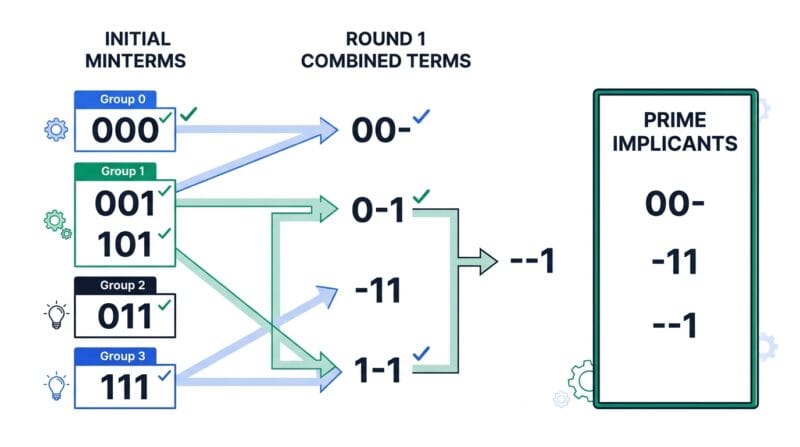
Here is the vocabulary that makes the rest click. An implicant is any product term that, when true, forces the function true — it covers one or more minterms. A prime implicant is one that has been combined as far as it can go: you cannot merge it with a neighbour to drop another variable. And an essential prime implicant is one that is the sole cover for at least one minterm, which means it has no substitute and must appear in the final answer.
Minimization is then a covering problem. Find every prime implicant, take all the essential ones because you have no choice, and then pick the fewest remaining implicants needed to cover whatever minterms are still uncovered. The elegance of this framing is that it turns a fuzzy “simplify it” instruction into a precise, mechanical procedure — which is what makes it programmable.
🟢 The Quine–McCluskey method, step by step
Write each minterm in binary. Group the terms by how many ones they contain, then compare every term in one group with every term in the next. If two differ in exactly one bit position, they can be combined: the differing bit becomes a dash, meaning “this variable does not matter here”, and you have eliminated a literal. This is the combining law, A B + A B’ = A, applied mechanically. Repeat on the newly combined terms, and keep repeating until nothing can be combined further. Anything that never got combined is a prime implicant.
Now build the prime implicant chart: implicants down the side, original minterms across the top, a mark where an implicant covers a minterm. Scan each column. If a minterm has exactly one mark, the implicant in that row is essential — select it, and cross off every minterm it covers. Whatever remains is a small covering problem you finish by choosing the fewest additional implicants. The result is the minimal Sum-of-Products, guaranteed, because the method exhausts the search space rather than relying on a lucky rearrangement.
This is the crucial difference from a Karnaugh map. A K-Map is the same idea drawn as a grid, and for two to four variables it is faster because your eye spots the groupings. But it relies on visual adjacency, and beyond four or five variables the grid becomes unreadable. Quine–McCluskey has no such ceiling — it is tedious by hand and trivial for a computer, which is precisely why it is the algorithm inside automated tools. If you want to see the grid version, the K-Map Solver shows the same minimization visually.
🟡 SOP, POS, and why NAND gates rule the world
Sum-of-Products describes the function through its ones: OR together the product terms that make it true. Product-of-Sums does the mirror image, describing the function through its zeros as an AND of sum terms. Both are valid, and one is often cheaper than the other depending on how many ones and zeros the function has — which is why it is worth generating both and comparing literal counts before committing.
The hardware twist is that neither AND–OR nor OR–AND is what actually gets fabricated. NAND and NOR are functionally complete, meaning any Boolean function can be built from NAND gates alone, or NOR gates alone. They are also cheaper in CMOS than an AND gate, which is internally a NAND followed by an inverter. So the standard move is to minimize to SOP, then convert directly to a NAND–NAND structure, which by De Morgan is exactly equivalent and maps straight onto real silicon. The Digital Logic Studio covers that conversion, and the 7400 Series IC Finder shows the physical chips those gates ship in.
🔴 Where the method stops
Two honest caveats. First, Quine–McCluskey is exhaustive, and exhaustive means expensive: the number of implicants can grow steeply as variables increase, so industrial synthesis tools use heuristic minimizers like Espresso that accept a near-optimal answer for a large speed gain. For anything up to eight variables — coursework, small designs — exhaustive is fine and gives you the guaranteed minimum.
Second, this is two-level minimization. It gives you the cheapest AND–OR structure, but a multi-level circuit found by factoring can sometimes be cheaper still, at the cost of extra propagation delay through the additional level. Real design trades those against each other. Once you understand what the two-level minimum is, you have the baseline against which any cleverer structure has to prove itself. To see the whole process worked out on your own expression, run it through the Boolean Algebra Studio, which prints the prime implicant chart and the gate-cost comparison alongside the answer.
What is a minterm?
A product term containing every variable, corresponding to one row of the truth table where the output is 1. The set of minterms defines the function completely.
What makes a prime implicant “essential”?
It is the only implicant covering some particular minterm. Since nothing else can cover that minterm, the essential implicant has to appear in the final minimal expression.
Is Quine–McCluskey better than a Karnaugh map?
It is more systematic and scales past four variables, where K-Maps get unreadable. K-Maps are faster by eye for small problems. They find the same minimum by different routes.
Why convert everything to NAND gates?
NAND is functionally complete and cheaper in CMOS than a plain AND. A minimized SOP maps directly onto a NAND–NAND structure by De Morgan, so it is the natural hardware target.
Should I use SOP or POS?
Whichever has fewer literals for your function. Functions with few ones usually favour SOP; functions with few zeros often favour POS. Generate both and compare.
What are don’t-care conditions?
Input combinations that can never occur, so the output does not matter. They can be treated as 1 or 0 — whichever produces a larger grouping and therefore a cheaper result.
Why do real chip designers not use Quine–McCluskey?
It is exhaustive, and cost grows steeply with variable count. Industrial tools use heuristics like Espresso that trade a guaranteed minimum for speed on very large functions.
Does fewer literals always mean a faster circuit?
Usually, since it means fewer gate inputs and less loading. But a two-level minimum is not always the fastest overall — multi-level factoring can trade an extra gate delay for fewer gates.