Best Advanced K-Map Solver Theory : Master Boolean Minimization

advanced-k-map-solver-rules

Best Advanced K-Map Solver: Master Boolean Minimization

Simplify complex digital logic instantly. Discover how an advanced k-map solver optimizes Boolean algebra equations offline with maximum privacy..

Advanced K-Map Solver

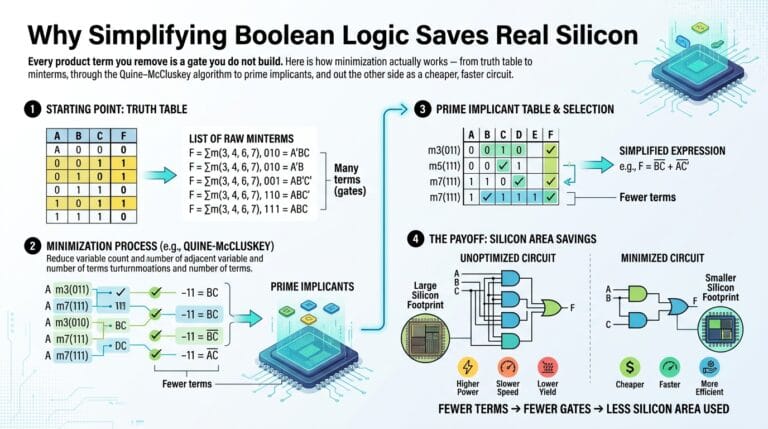
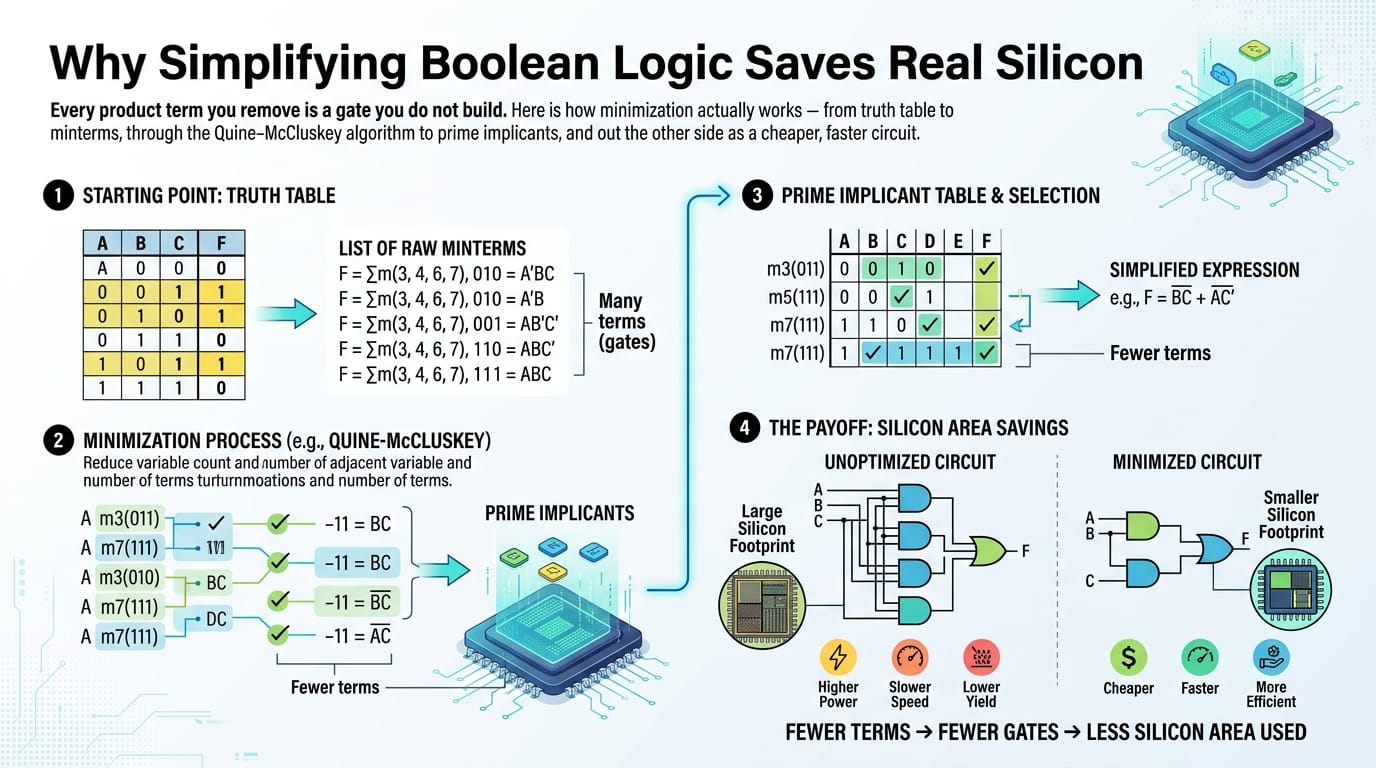
Designing efficient digital circuits requires absolute precision, and utilizing an advanced k-map solver is the most effective way to minimize hardware complexity. In the fields of computer engineering and discrete mathematics, reducing the number of logic gates in a circuit directly correlates to lower manufacturing costs, reduced power consumption, and significantly faster processing speeds.

The foundational method for achieving this minimization is the Karnaugh map (or K-map), introduced by Maurice Karnaugh in 1953. This pictorial method acts as a massive visual aid to simplify Boolean algebra expressions without the need to memorize and apply extensive algebraic theorems iteratively.

🟥 The Mathematical Theory Behind Logic Minimization

In raw Boolean algebra, an expression might look like $Y = \overline{A}\overline{B}C + \overline{A}BC + AB\overline{C} + ABC$. Attempting to factor and reduce this equation manually using theorems like $X + \overline{X} = 1$ is highly prone to human error, especially as the number of variables increases. An advanced k-map solver translates this algebraic chaos into a highly structured grid.

The grid itself is organized using Gray code sequencing ($00, 01, 11, 10$). This specific non-binary sequence is critical because it ensures that only a single bit changes between any two adjacent cells, whether horizontally or vertically. Because of this single-bit shift, adjacent cells containing a logical ‘1’ represent boolean terms that differ by exactly one variable. According to the foundational theorem $AX + A\overline{X} = A$, that differing variable can be completely eliminated. The larger the contiguous block of 1s you can identify, the more variables you can successfully strip from the final logical equation.

🟧 Why Engineers Rely on an Advanced K-Map Solver

While computing a simple two-variable expression is trivial, modern microprocessor design often involves vast, highly complex logic arrays. A standard 4-variable K-map contains 16 unique cells, while a 5-variable K-map expands into a 32-cell, multi-layered three-dimensional puzzle. Navigating these overlapping topologies to find essential prime implicants by hand is a massive drain on engineering resources. Deploying an automated advanced k-map solver completely eliminates the tedious visual processing, guaranteeing the mathematically optimal Sum of Products (SOP) or Product of Sums (POS) expression in milliseconds.

Prime Tool Hub Video

🟨 Practical Application of Logic Groupings

Understanding how an advanced k-map solver interprets visual data is crucial for mastering digital logic design. The software algorithm automatically scans the multi-dimensional grid to identify the largest possible power-of-two groupings, wrapping around the edges of the map like a torus.

To achieve maximum minimization, the underlying theory dictates these specific grouping rules:

🟢 Pairs (2 Cells): Grouping two adjacent 1s successfully eliminates exactly one logic variable from the final term.

🔵 Quads (4 Cells): Forming a square or line of four adjacent 1s eliminates two unique variables simultaneously.

🟣 Octets (8 Cells): Grouping a massive block of eight 1s strips three variables, resulting in highly efficient logic.

🟤 Essential Prime Implicants: The algorithm prioritizes groupings that contain at least one ‘1’ that cannot be covered by any other overlapping group, ensuring the final hardware blueprint is as compact as mathematically possible.

🟩 Transitioning to Professional Tools

Bridging the gap between theoretical discrete mathematics and practical, deployable hardware engineering requires robust, professional-grade software. Once you fully understand the mechanics of Gray code, prime implicants, and boolean minimization, the next step is to integrate a dedicated advanced k-map solver into your daily academic or commercial workflow.

For unparalleled accuracy, speed, and security, we highly recommend utilizing the solver provided directly on our platform. This meticulously engineered advanced k-map solver is built from the ground up to respect your proprietary data. Unlike cloud-based logic calculators that process your schematics on remote, unsecure servers, our tool is strictly 100% offline and client-side.

This localized architecture guarantees absolute military-grade user privacy with zero server latency. Your complex logic grids and academic homework never leave your local web browser. Furthermore, there is absolutely no signup, subscription, or registration required to access its full computational power instantly.

If you are looking to expand your utility belt with more hyper-secure, mathematically precise applications, explore the comprehensive collection available in our free web tools directory. We are dedicated to providing the global engineering community with resources that prioritize data sovereignty above all else.

Do not let the exponential complexity of multi-variable logic slow down your project deadlines or inflate your printed circuit board costs. Try out the advanced k-map solver today and experience the speed, accuracy, and absolute privacy of modern client-side processing completely for free.

Best Truth Table Generator: Master Boolean Logic Offline

Truth Table Generator

Best Truth Table Generator: Master Boolean Logic Offline

Need a reliable truth table generator? Master Boolean algebra and evaluate complex logic expressions instantly with our 100% offline, privacy-first tool.

Truth Table Generator

🟥 Mastering Propositional Logic

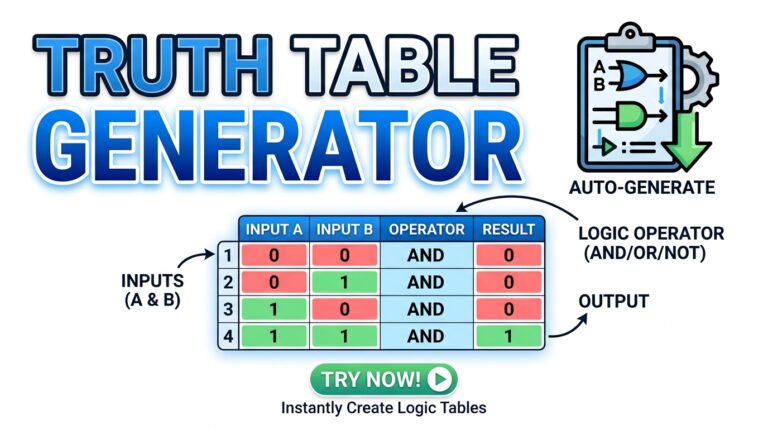
In the realms of computer science, digital electronics, and discrete mathematics, evaluating the validity of logical arguments is a foundational requirement. Whether you are designing the architecture for a new microprocessor or proving a complex theorem in algorithmic logic, having access to a reliable truth table generator is essential for validating your theoretical work efficiently.

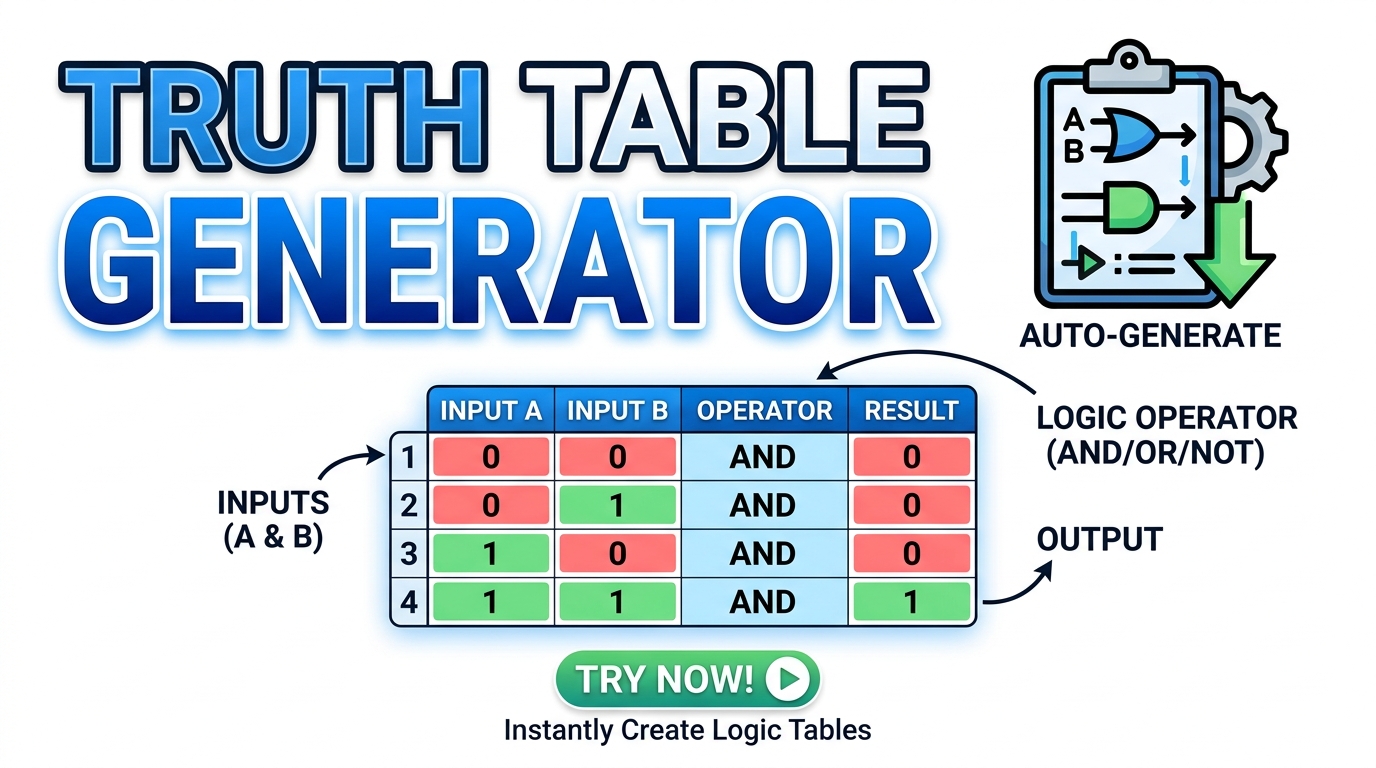
At the core of this mathematical discipline lies Boolean algebra. Unlike elementary algebra where variables represent numbers, in Boolean algebra, the variables strictly represent truth values—typically denoted as True (1) and False (0). To map out every possible outcome of these variables when subjected to various logical operators (such as AND, OR, NOT, XOR, and IMPLICATION), mathematicians utilize a structured diagram known as a truth table. This table acts as a complete, exhaustive mathematical breakdown, showing the functional output for every conceivable combination of inputs.

🟧 The Mathematical Complexity of Logic

While evaluating a basic expression with two variables (like $P$ AND $Q$) only requires four rows, the complexity of a truth table scales exponentially. The formula for determining the number of rows is $2^n$, where $n$ represents the total number of unique variables in the logical expression. Therefore, an expression containing just five variables requires a massive table with 32 distinct rows.

Attempting to compute these grids manually is incredibly tedious and highly susceptible to human error. A single misplaced zero in a preliminary column will corrupt the final functional output of the entire mathematical proof. This inherent difficulty is precisely why understanding the underlying theory must be paired with utilizing a modern truth table generator to ensure absolute accuracy in complex logical evaluations.

Prime Tool Hub Video

🟨 Practical Application of Logic Arrays

When you transition from the core theory of Boolean mathematics to practical application, understanding the strict order of operations becomes vital. A high-quality truth table generator processes logical syntax exactly as a mathematician would, adhering to established precedence rules.

To correctly evaluate a complex compound proposition, one must follow these fundamental algorithmic steps:

🟢 Isolate the Variables: Identify all unique propositional variables to determine the baseline matrix size ($2^n$ rows).

🔵 Evaluate Parentheses: Just like in standard arithmetic, innermost nested brackets and parentheses must be resolved first.

🟣 Apply Negation: Execute all NOT ($\neg$) operators on their immediate adjacent variables.

🟤 Process Conjunctions and Disjunctions: Evaluate the AND ($\land$) and OR ($\lor$) operators systematically from left to right.

By breaking down a massive expression into smaller, manageable sub-expressions, the final truth value is derived logically. However, as these expressions grow in length, relying on an automated truth table generator is the most efficient way to bypass the manual labor and instantly achieve perfectly calculated results.

🟩 Why You Need a Truth Table Generator

Bridging the gap between theoretical discrete mathematics and practical engineering workflows requires robust, specialized software. Once you have a firm grasp on how propositional logic and exponential row scaling function, the next logical step is to integrate a dedicated truth table generator into your daily academic or professional toolkit.

For unparalleled accuracy and speed, we highly recommend utilizing the Truth Table Generator provided directly on our platform. This advanced truth table generator is meticulously engineered to handle complex compound propositions with instantaneous precision.


What truly sets this specific tool apart from other academic resources is its underlying architecture. It is built to be 100% offline and strictly client-side. This means that when you input proprietary logic equations or sensitive academic homework, the data never leaves your local machine. This guarantees absolute military-grade user privacy with zero server latency. There are no databases storing your work, and absolutely no signup, subscription, or registration required to access its full computational power.

If you want to explore a wider ecosystem of highly secure, mathematically precise utilities, you can browse the extensive collection in our free web tools directory. Our platform is dedicated to providing engineers and students with powerful resources that respect user data privacy above all else.

Do not let the exponential complexity of Boolean algebra lead to frustrating manual errors. Embrace the efficiency of modern logic computing and utilize our truth table generator today to streamline your mathematics completely for free.

Best Universal Logic Gate Converter: Simplify Digital Design

universal-logic-gate-converter

Best Universal Logic Gate Converter: Simplify Digital Design

Discover the ultimate universal logic gate converter to simplify complex digital circuits. Learn Boolean theory and optimize your designs offline today.

universal logic gate converter

Designing digital circuits can be incredibly complex without the correct methodologies and resources. Whether you are an electronics engineering student studying computer architecture or a seasoned hardware designer drafting a new motherboard, utilizing a reliable universal logic gate converter is an absolute necessity for streamlining your workflow.

At the foundational level of all computing hardware lie logic gates. These microscopic building blocks perform the fundamental logical functions required for any digital circuit to operate. The entire concept is deeply rooted in Boolean algebra, a branch of mathematics formulated by George Boole in the 19th century that maps logical truth values to binary numbers.

🟥 The Core Theory of Logic Gates

Standard digital hardware relies on three primary logic gates: AND, OR, and NOT. An AND gate outputs a true signal only if all of its inputs are true, mathematically expressed in Boolean algebra as $Y = A \cdot B$. Conversely, an OR gate outputs a true signal if at least one of its inputs is true, denoted as $Y = A + B$. Finally, the NOT gate serves to simply invert the input signal, shown as $Y = \overline{A}$.

🟧 Why You Need a Universal Logic Gate Converter

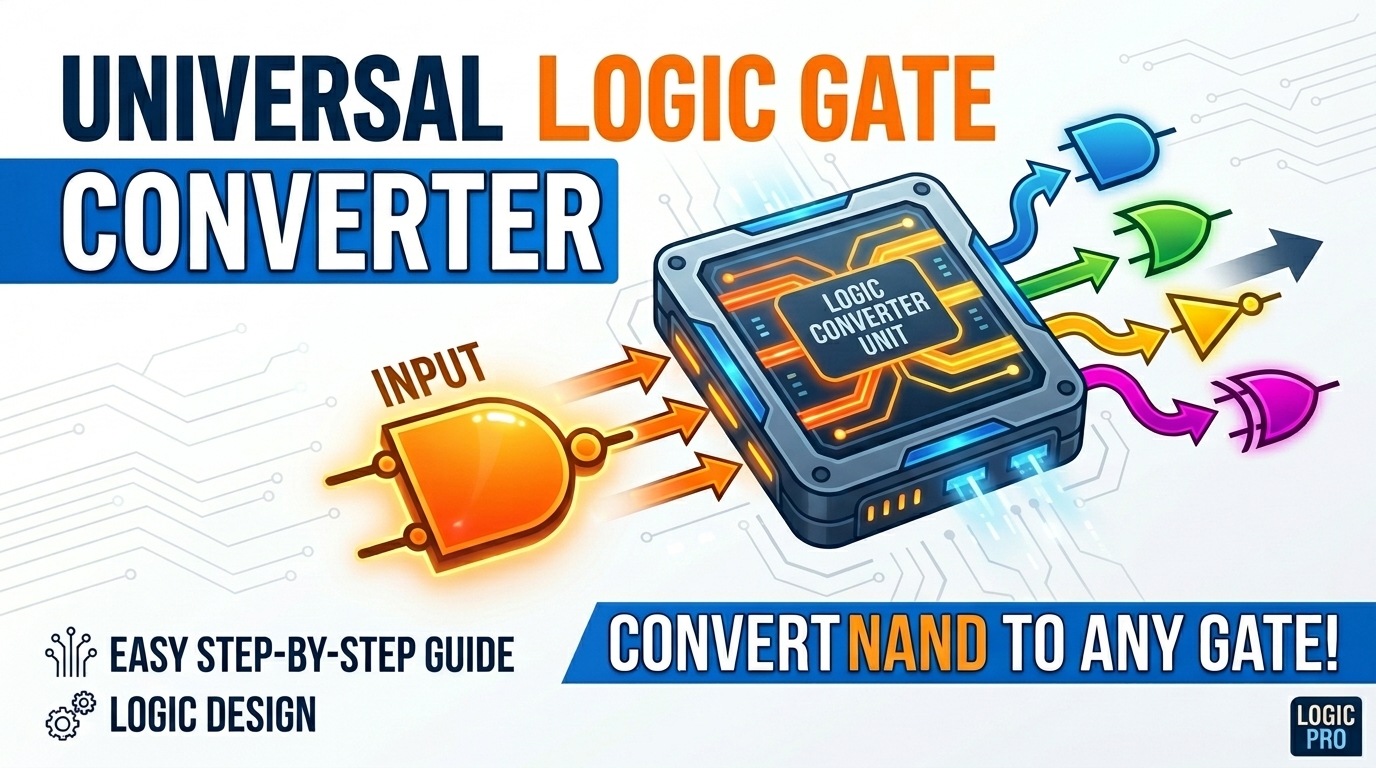
In practical hardware manufacturing, designing circuits using a mixed variety of AND, OR, and NOT chips is often highly inefficient and expensive. This is exactly where the power of universal logic comes into play. NAND and NOR gates are uniquely classified as “universal” because a designer can construct any other logical function imaginable using only these specific gates. A robust universal logic gate converter helps engineers instantly translate complex mixed-gate Boolean expressions into simplified circuits utilizing exclusively NAND or NOR configurations.

For instance, the fundamental NAND function is represented algebraically as $Y = \overline{A \cdot B}$. By tying the inputs of a NAND gate together, it mimics the behavior of a NOT gate. By combining multiple NAND gates in specific cascades, you can flawlessly replicate standard AND and OR functions, drastically reducing the unique variety of microchips needed on a printed circuit board. Utilizing an automated universal logic gate converter handles this intricate mathematical translation instantly, saving countless hours of manual calculation.

Prime Tool Hub Video

To fully grasp the theoretical power of these hardware transformations, engineers rely on De Morgan’s Laws. These foundational rules dictate how logical statements interact with negation, formulated as $\overline{A \cdot B} = \overline{A} + \overline{B}$ and $\overline{A + B} = \overline{A} \cdot \overline{B}$. These theorems prove mathematically that designers can swap logical ANDs for ORs by simply inverting the specific inputs and outputs. Manually applying De Morgan’s formulas to a circuit with dozens of variables is tedious and highly prone to human error.

Seeing this mathematical theory executed in action makes it significantly easier to comprehend. When you transition these concepts into real-world applications, you will discover several critical engineering advantages. Relying on a proficient universal logic gate converter provides the following practical benefits for digital logic design:

🟢 Reduces the overall component count on crowded circuit boards.

🔵 Lowers hardware manufacturing costs by standardizing bill-of-materials to strictly NAND or NOR chips.

🟣 Simplifies testing and troubleshooting protocols during quality assurance.

🟤 Minimizes signal propagation delay when complex logic paths are optimized correctly.

As educational demonstrations often highlight, translating an intricate sum-of-products expression into a strict NAND-NAND logic level implementation requires careful and deliberate manipulation. By standardizing the logic gates across the board, hardware engineers achieve vastly superior manufacturing efficiency. It is vital to practice these theoretical conversions to understand the underlying mechanics before moving to automated solutions.

Transitioning from theoretical Boolean mathematics to practical circuit deployment requires powerful, reliable software. After mastering the foundational concepts of De Morgan’s laws and the inherent flexibility of universal gates, the next logical step is to integrate a dedicated universal logic gate converter into your daily engineering workflow.

We highly recommend utilizing the Universal Logic Gate Converter Pro available directly on our platform. This highly specialized universal logic gate converter is designed from the ground up for maximum computational efficiency and strict data security.

Unlike many online utilities that process sensitive schematic data on remote servers, this specific tool operates entirely within your local web browser. It is uniquely engineered to be 100% offline and client-side. This architecture guarantees absolute military-grade user privacy with zero server latency. You never have to worry about your proprietary circuit designs, academic homework, or corporate logic diagrams being uploaded, stored, or intercepted. Furthermore, there is absolutely no signup, subscription, or registration required to use the platform. You simply load the page and begin your conversions immediately.

To discover more engineering utilities that follow this strict privacy-first, client-side architecture, you can browse the comprehensive collection in our free web tools directory. Whether you need to simplify an extensive equation for a university computer science assignment or optimize a complex schematic for mass production, our utilities are built to deliver instant, secure results.

Do not let complex boolean algebra slow down your project timeline or inflate your manufacturing costs. Try out the universal logic gate converter today and experience the speed and security of purely offline, client-side processing completely for free.

The Complete Guide to 7400 Series Logic Gates & TTL ICs

7400 series logic gates

Master the fundamentals of 7400 series logic gates and TTL ICs.

Learn how to read pinouts, design circuits, and use our free offline IC finder tool.

7400 series logic gates

The Complete Guide to 7400 Series Logic Gates & TTL ICs

If you are diving into computer engineering, robotics, or digital electronics anywhere in the world, mastering 7400 series logic gates is your first critical step. Whether you are building a simple breadboard project or studying complex Boolean algebra, these universal chips are the absolute foundation of modern computing hardware.

In this comprehensive guide, we will explore how these components work, the different types available, and how you can easily identify their pinouts for your next digital circuit project.

Prime Tool Hub Video

In a standard TTL environment, the logic levels are strictly defined by voltage:

🟢Logic 0 (LOW): Voltage between 0V and 0.8V.

 🟣Logic 1 (HIGH): Voltage between 2.2V and 5V.

Core Types of 7400 Series Logic Gates

🟨 There are hundreds of chips in this family, but every electronics enthusiast should know these essential building blocks:

  • 🟣 7404 (NOT Gate / Hex Inverter): Reverses the input. A HIGH input becomes a LOW output.
  • 🟠 7408 (AND Gate): The output is HIGH only if both inputs are HIGH.
  • 🔵 7432 (OR Gate): The output is HIGH if at least one input is HIGH.
  • 7400 (NAND Gate): A universal gate. It outputs LOW only when both inputs are HIGH.
  • 🟤 7402 (NOR Gate): Another universal gate. It outputs HIGH only when both inputs are LOW.

🟩 How to Read the Pinout Correctly

Reading the pinout of 7400 series logic gates correctly is vital to prevent short circuits. Most of these chips come in a 14-pin Dual In-line Package (DIP).

  1. Locate the Notch: Look for a small half-circle notch or dot at one end of the chip.
  2. Find Pin 1: Pin 1 is always the first pin to the left of that notch.
  3. Connect Power: For standard 14-pin ICs, Pin 7 is Ground (GND) and Pin 14 is the Power Supply (VCC / 5V).

🟥 Frequently Asked Questions (Q&A)

Q1: Can I use 7400 series ICs with a 9V battery? No. Standard TTL chips require a strictly regulated 5V power supply. Using a 9V battery directly will permanently damage the IC. Always use a voltage regulator like the LM7805.

Q2: What is the difference between 74LS and 74HC series? The “LS” stands for Low-power Schottky (a faster, lower-power TTL), while “HC” stands for High-speed CMOS. HC chips consume much less power but handle different voltage thresholds. You can read more about the technical specifications in the official TI Logic Selection Guide.

Q3: Are these chips still used today? Absolutely! While complex devices use microprocessors, 7400 series logic gates are still heavily used worldwide in educational kits, hardware debugging, and legacy system repairs.

Q4: How do I find “Pin 1” on a 7400 series IC? Look for a small semi-circular notch or a tiny circular dimple on one end of the black plastic casing. If you hold the chip with this notch facing up (or to the left), Pin 1 is the very first pin on the top-left side. Pins are always counted counter-clockwise from there. Refer to this IC Pinout Guide for visual counting methods.

Q5: What happens if I leave an input pin unconnected? In standard TTL logic, an unconnected (floating) input typically registers as a logic HIGH (1). However, it acts like a tiny antenna and can pick up electrical noise, causing random switching and unstable circuits. It is always a best practice to connect unused inputs securely to VCC (High) or Ground (Low).

🟪 Simplify Your Workflow with Our Free Tool

Memorizing complex datasheets and internal pinout diagrams can slow down your project. If you want to find pinouts and technical details instantly, we have the perfect solution.

Try our completely free, offline-capable 7400 Series IC Finder. This tool helps you quickly search, view DIP pinout diagrams, and get technical mapping for your logic gates without needing heavy PDF datasheets. Bookmark it today to speed up your digital electronics design process!

Choose a language