
HTML Entity Encoder Decoder: Free Offline Client-Side Tool
Master the html entity encoder decoder with this 100% offline client-side tool. Instantly encode and decode HTML entities, CSS escapes, and JS Unicode with zero uploads and military-grade privacy. No signup required – secure your code now at Prime Tool Hub.

🟥 The Complete Developer Guide to Using an HTML Entity Encoder Decoder
Writing web tutorials, sharing programming snippets, or building secure community forums all share one major technical challenge: you cannot simply paste raw programming syntax directly into a web page. Web browsers are designed to interpret specific symbols as active commands. If you type a less-than sign or an ampersand into your content, the browser’s parsing engine tries to execute it rather than display it. This instantly breaks your page layout and hides your actual content. To solve this structural problem, frontend developers rely on an HTML Entity Encoder Decoder to safely translate dangerous code characters into harmless visual text.
🟧 How Browser Tokenization Causes Layout Errors
To fully grasp why we need these utilities, we have to look closely at how a web browser processes data. When Google Chrome or Mozilla Firefox downloads your website, it builds a Document Object Model (DOM). During this phase, the browser runs a “tokenizer” that reads your file character by character. When it spots a < symbol, it assumes a new HTML tag is starting.
If you are writing a blog post about JavaScript and you type a code block containing <div>, the browser will literally create a new invisible container on your screen instead of printing the text. An HTML Entity Encoder Decoder stops this behavior. It converts that specific symbol into a named entity reference, changing it to <. The browser knows that this specific string of letters is a command to draw the symbol visually, completely bypassing the execution engine.
These translation rules are not random. They are heavily regulated by the World Wide Web Consortium (W3C). The W3C maintains a massive database of character references that modern browsers must support. You can study the exact technical specifications for these text transformations on the official W3C HTML specification page. Using a reliable HTML Entity Encoder Decoder ensures that your text perfectly matches these global standards.
🟦 Stopping XSS Attacks with an HTML Entity Encoder Decoder
Fixing broken layouts is great, but the absolute most important reason developers use an HTML Entity Encoder Decoder is cybersecurity. One of the oldest and most dangerous hacking techniques on the internet is Cross-Site Scripting (XSS). This happens when a malicious user successfully tricks your website into running their own JavaScript code on someone else’s computer.
Imagine you build a comment section for a blog. A hacker submits a comment containing a malicious script payload. If your database saves that raw code, the next innocent user who visits the page will unknowingly execute that script. The hacker can steal their session cookies and hijack their login access. You can explore exactly how these dangerous injections work on the Mozilla Developer Network XSS documentation.
🟩 Complete Input Sanitization
You can stop these attacks completely by sanitizing every single piece of user input. By passing all submitted text through an HTML Entity Encoder Decoder before saving it, the dangerous <script> tags are instantly neutralized into <script>. The malicious code is rendered as harmless visual text on the screen, keeping your entire user base perfectly safe.
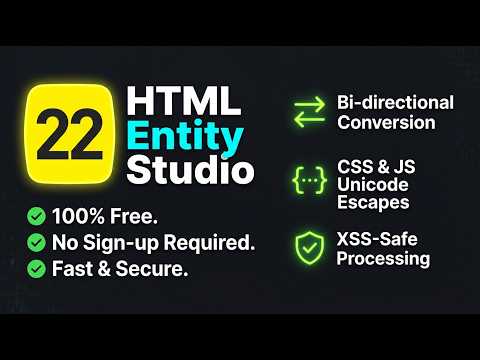
While basic entities cover standard web pages, modern software development involves more complex environments. Sometimes you need to inject a specific symbol dynamically using a JavaScript string, or you need to add an icon through a CSS stylesheet. An advanced HTML Entity Encoder Decoder supports multiple output formats. It can generate JS Unicode escapes (like \u003C) for script variables, and CSS hex escapes (like \003C) for styling rules, making it a highly versatile utility for full-stack engineering.
🟨 The Power of Offline Client-Side Processing
Many amateur programmers rely on cloud-based conversion tools they find on search engines. This is a massive mistake. If you are documenting an unreleased company software project or cleaning up proprietary backend code, pasting that text into a server-based HTML Entity Encoder Decoder exposes your private logic to the public internet. The owners of that website can easily log and save your secret code.
To solve this major privacy issue, our HTML Entity Encoder Decoder is engineered to operate 100% offline. Because it runs purely on client-side JavaScript, the entire text translation process happens directly inside your web browser’s temporary memory. Absolutely zero data is uploaded to our servers. You get enterprise-grade code formatting while maintaining total data sovereignty.
🟪 Expanding Your Development Workspace
A fast, local HTML Entity Encoder Decoder is an essential starting point for secure software design. However, building reliable applications requires a complete set of trusted tools. After you sanitize your raw code snippets, you might need to establish secure tracking IDs for your new database records. You can instantly create those unique identities without leaving your browser by using a secure UUID GUID Generator Validator Tool.
Also, if you are tired of manually typing out huge blocks of technical documentation, you can give your hands a break. Try dictating your engineering notes directly into your computer using our completely private Free Offline Voice Typing Studio.
By actively using an HTML Entity Encoder Decoder in your daily workflow, you guarantee that your web pages will never break, your databases remain safe from injection attacks, and your proprietary code stays entirely on your own device.