HTML Entity Encoder & Decoder
Safely encode and decode HTML entities, CSS escapes, and JS Unicode offline. Perfect for web developers displaying code snippets securely without breaking layouts.
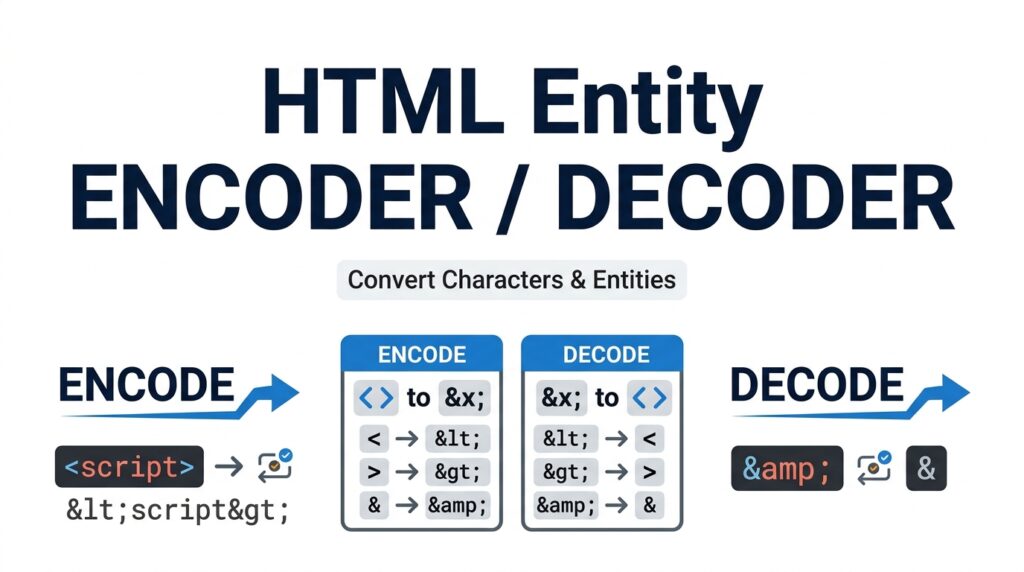
Table of Contents
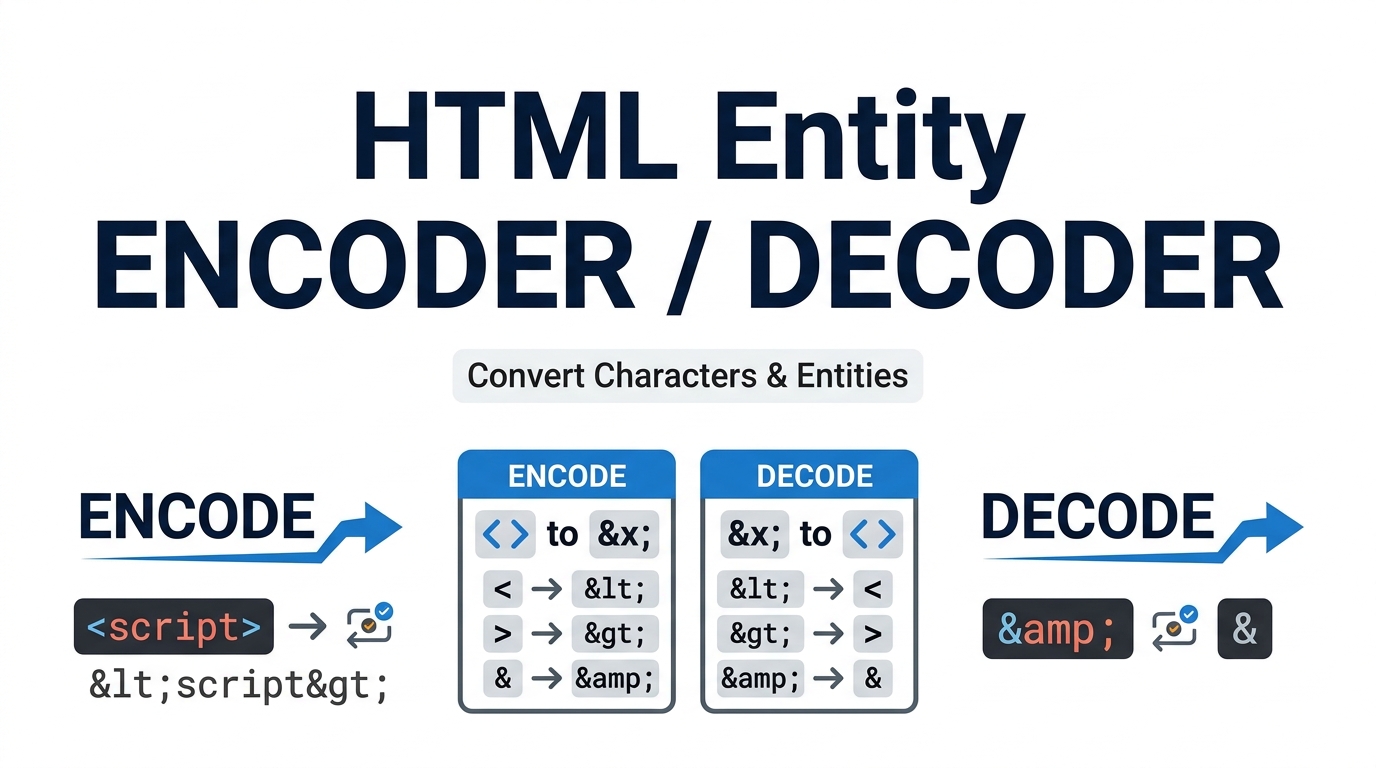
Trying to show a literal angle bracket or ampersand on a page without the browser treating it as markup? Convert characters to their HTML entities so they display as text, or decode entities back to plain characters. Handy when you are pasting code samples into an article.
⌨️ HTML Entity Studio
Why use an Encoder?
When displaying programming tutorials or code blocks on your website, browsers will interpret symbols like < and > as actual HTML tags. Encoding converts them into safe text strings.
Common HTML Entities
| Char | Entity Name | Entity Number |
|---|
innerHTML, use the JS Unicode format. If injecting via a CSS content: "" rule, use the CSS Escape format.Instantly scans your text strings to identify and convert reserved syntax into safe, universally compatible structural code.
Seamlessly toggles between securing raw inputs and reversing previously sanitized data back into human-readable formats.
Neutralizes malicious script injections by mathematically escaping sensitive symbols before they render in the DOM.
Paste your raw text, source code snippets, or unformatted strings directly into the primary HTML Entity Encoder input field.
Choose your algorithmic action. Select ‘Encode’ to secure reserved symbols or ‘Decode’ to revert an already sanitized string.
The internal processor immediately intercepts your logic, translating the characters via local client-side memory execution.
Review the translated output and click the copy button to safely integrate the validated code directly into your stylesheet or markup.
🟥 The Importance of an HTML Entity Encoder in Web Development
Modern web browsers render content by interpreting specific reserved characters like angle brackets and ampersands. If developers attempt to display these exact symbols on a webpage without proper escaping, the browser may misinterpret the text as executable markup. An advanced HTML Entity Encoder solves this rendering conflict by mathematically translating these characters into secure, standardized text strings. Utilizing a reliable HTML Entity Encoder guarantees that complex code snippets display perfectly on the frontend without breaking your site’s architectural layout.
🟧 XSS Prevention and Algorithmic Security
Frontend security requires aggressive input sanitization. Cross-Site Scripting (XSS) attacks occur when malicious actors inject active scripts into vulnerable input fields. An HTML Entity Encoder acts as a critical defensive barrier, replacing dangerous syntax with inert character references. For a deeper academic understanding of this structural translation, developers can review the official Wikipedia entry on character entities. By processing inputs through an HTML Entity Encoder, software engineers effectively neutralize executable payloads before they can compromise the database.
🟨 Bi-Directional Decoding and Data Retrieval
While escaping characters is mandatory for secure rendering, retrieving the original text is equally important for database administration and content management systems. A robust HTML Entity Encoder includes a reverse algorithmic engine capable of decoding complex entities back into their raw state. This bi-directional functionality ensures that an HTML Entity Encoder remains a versatile utility, allowing developers to read, edit, and safely re-encode historical database records with zero data loss.
🟩 Local Processing with a Secure HTML Entity Encoder
Transmitting raw source code or proprietary text through external application programming interfaces introduces severe network privacy risks. This specific HTML Entity Encoder executes all string replacements and validation logic strictly within the local browser sandbox. For engineers seeking additional offline utilities, please explore our Free Web Tools Directory. Deploying a client-side tool ensures your underlying string arrays and formatting logic never leave your physical workstation.
🤔 Frequently Asked Questions
1. What exact characters does an HTML Entity Encoder replace?
The algorithmic engine targets critical reserved syntax, transforming characters like less-than (<), greater-than (>), ampersands (&), and quotes into their respective, inert Unicode equivalents.
2. Does the HTML Entity Encoder protect against code injection?
Yes. By translating active structural markup into secure text strings, the tool neutralizes Cross-Site Scripting (XSS) payloads, rendering them harmless when displayed within the Document Object Model.
3. Can I reverse the translation back to raw text?
Absolutely. The built-in decoding module actively identifies encoded strings and reverses the mathematical translation, cleanly restoring your original, editable source code.
4. Is my raw source code sent to an external server?
No. All string parsing, mathematical replacement, and data extraction occur entirely within your device’s local browser memory, ensuring your proprietary code remains strictly confidential.