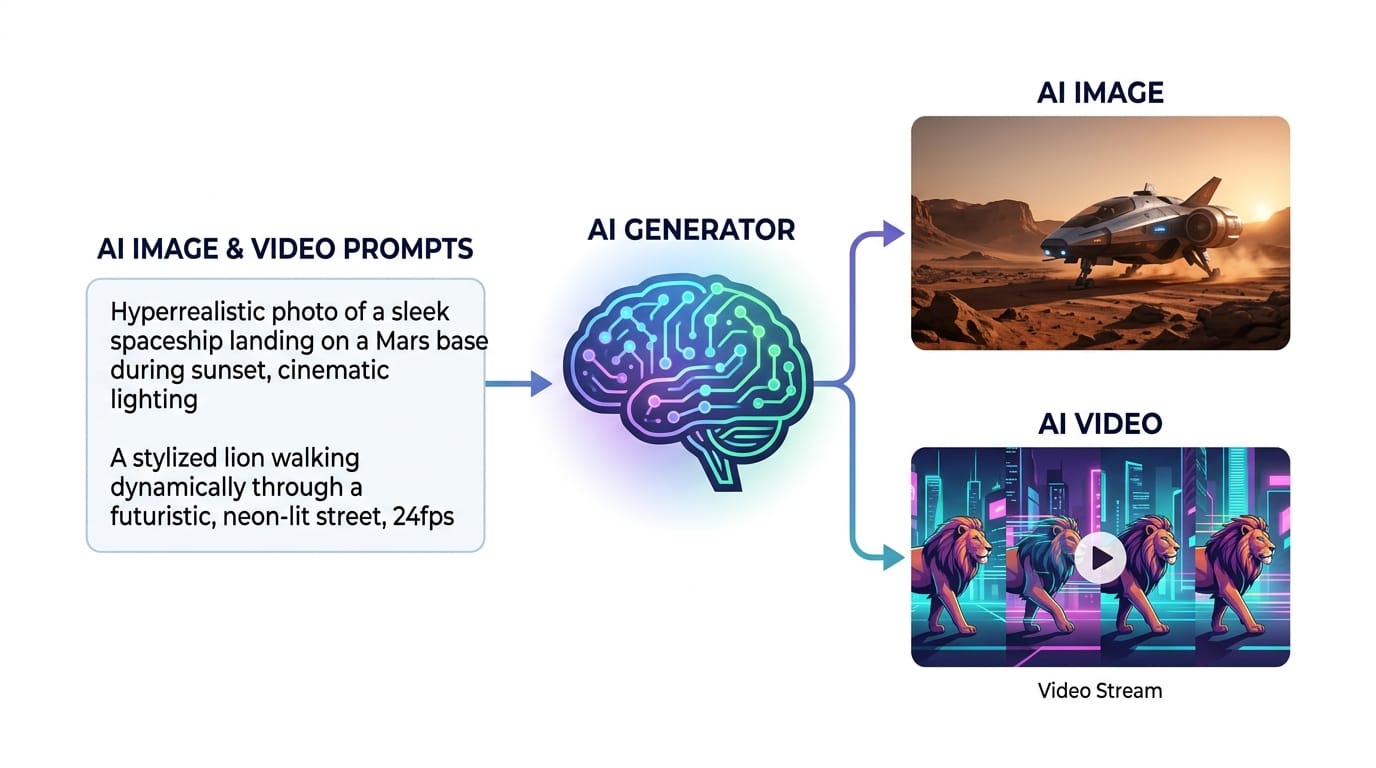
Why Your Words Change the Picture
An image model does not draw. It removes noise, thousands of times, and your prompt is the instruction that steers every one of those steps. Understand that loop and prompt engineering stops being superstition and starts being a craft.
Table of Contents
Last updated: July 2026
🔴 Diffusion: sculpting a picture out of static
Start with the counter-intuitive part. A diffusion model does not begin with a blank canvas and add strokes. It begins with a field of pure random noise — television static — and repeatedly asks a single question: if this were a slightly noisy version of a real image, what would the noise look like, and what happens if I subtract it? Do that twenty or fifty times and structure emerges from the static, the way a shape resolves out of fog.
The model learned this by being shown millions of images with noise progressively added until they were destroyed, and being trained to reverse each step. So it is very good at one narrow trick: predicting the noise. Everything else — composition, lighting, faces — is a side effect of running that trick over and over. Your prompt does not paint anything. It biases the guess at every step, nudging each round of denoising toward images that match your words.
🟡 How the model reads your prompt (and why word order matters)
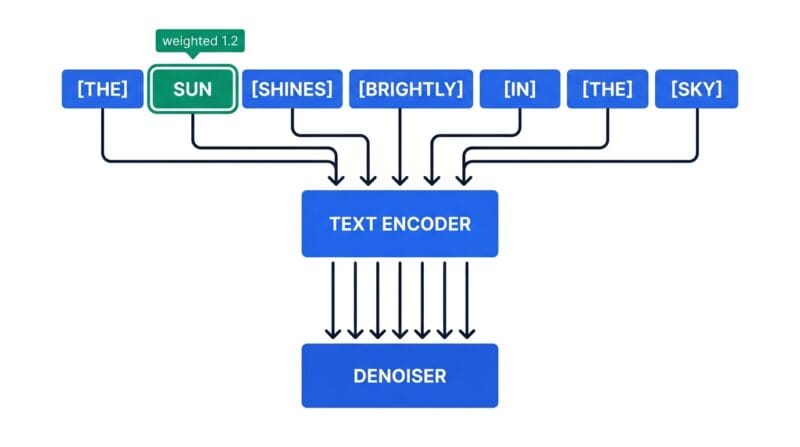
Your text never reaches the image part of the model as words. A text encoder — historically a CLIP model, now often a larger language model — chops the prompt into tokens and turns them into vectors, a list of numbers capturing what each token means and how it relates to the others. Those vectors are what the denoiser actually consults, through a mechanism called cross-attention, on every single step. When you write golden hour, the model is not looking up a definition; it is reaching for a region of learned space that thousands of golden-hour photographs occupied.
This explains several things that otherwise look like folklore. Word order matters because attention is not perfectly uniform — the opening tokens tend to exert more influence, which is why burying your subject at the end of a long prompt weakens it. Cinematography vocabulary works unusually well because those terms are heavily represented in the captions the model was trained on: images labelled with 85mm, Rembrandt lighting or anamorphic really did look a certain way, consistently, thousands of times. And weighting a term in brackets is not magic either — it literally scales that token’s influence in the attention calculation, which is exactly why cranking it past about 1.5 starts bending the rest of the image around it.
🟢 Negative prompts and the guidance dial
A negative prompt is not a filter applied at the end. The model runs its noise prediction twice at each step: once conditioned on what you asked for, and once on what you asked to avoid. It then pushes the result away from the second and toward the first. The strength of that push is the guidance scale, and it is a genuine trade-off — turn it up and the image obeys your prompt more literally but grows harsh and over-saturated; turn it down and it becomes more natural but drifts from what you asked.
Understanding that mechanism explains why stuffing thirty terms into your negative field backfires. Every negative token is another direction to push away from, and the pushes interfere with one another and with your positive prompt. Two or three negatives that name the actual defect will outperform a copy-pasted wall of them, every time. The seed is the other half of the story: it is the starting random noise. The same prompt with the same seed and settings reproduces the same image exactly, which is what makes iteration possible. Change one word, keep the seed, and you can see precisely what that word did.
🟡 Video adds a whole new problem: time
Generating twenty-four consistent images is not the same as generating one image twenty-four times. If each frame were denoised independently the result would boil — faces would shift, clothes would change colour, the world would flicker. Video models add temporal layers so that frames attend to each other, learning that a face at frame ten should be the same face at frame eleven and that objects move along plausible paths.
That is why video prompts are written differently. They read as sentences describing an action over time, they name the camera movement explicitly, and they tend to include stability instructions like consistent lighting or no morphing, because the model is being asked to hold something steady while changing it. It also explains why simple motion works and complicated motion collapses: one clear camera move over five seconds is within reach, while a complex multi-beat action asks the model to maintain coherence across far more change than it can reliably manage. And it is why character consistency across separate shots is genuinely hard — each clip is its own generation, which is exactly why reusing one locked scene description across every shot in a sequence is not a stylistic preference but a practical necessity.
🔴 What all this means in practice
Put the theory back together and a short, honest set of rules falls out. Front-load your subject. Use vocabulary the model has genuinely seen, which is why real cinematography terms beat invented ones. Keep negatives few and specific. Lock the seed when you are iterating so you are testing one variable, not rolling dice. Prefer one clear camera move to a complicated one. And describe, rather than command — the model has no notion of obeying an instruction, only of matching a description.
There is also a privacy dimension worth naming. Cloud generators receive every prompt you write, and prompts for unreleased campaigns or client concepts are commercially sensitive. Running a model locally in the browser keeps them on your machine, and the Browser AI Models Directory lists what your hardware can realistically handle, while how browser AI models work explains the engines that make it possible and client-side data processing covers why it matters. When you are ready to write prompts with real cinematographic control, the Cinematic Prompt Studio puts the shot, lens, light and grade decisions in front of you and formats the result for whichever model you are using.
How does a diffusion model actually make an image?
It starts from random noise and repeatedly predicts and subtracts the noise. Your prompt steers each of those denoising steps, so the picture emerges from static rather than being drawn.
Why does word order change the result?
The prompt is turned into tokens, and attention is not perfectly even across them. Opening tokens tend to carry more influence, so your subject should come first, not last.
Why do cinematography terms work so well?
Because they appeared consistently in the captions the model trained on. Words like 85mm, Rembrandt lighting or anamorphic map to a real, repeatable visual pattern the model has learned.
What does a negative prompt really do?
The model predicts noise twice, once for what you want and once for what you do not, then pushes away from the second. It is a direction, not a filter applied afterwards.
Why can too many negatives make things worse?
Each one adds another direction to push away from, and they interfere with each other and with your positive prompt. Two or three specific negatives beat a long copied list.
What is a seed?
The starting random noise. Same seed, same prompt, same settings gives the same image, which lets you change one word and see exactly what that word did.
What is guidance scale?
How hard the model is pushed toward your prompt. Higher means more literal but harsher and often over-saturated; lower means more natural but looser. It is a genuine trade-off.
Why is video so much harder than a still?
Frames must stay consistent with each other, not just match the prompt. Video models add temporal layers so frames attend to one another, which is why simple camera moves succeed and complex action collapses.